
Scrub notes
Choosing the best electric scrub brush for the shower
By TUYU Home Care · Updated October 11, 2026
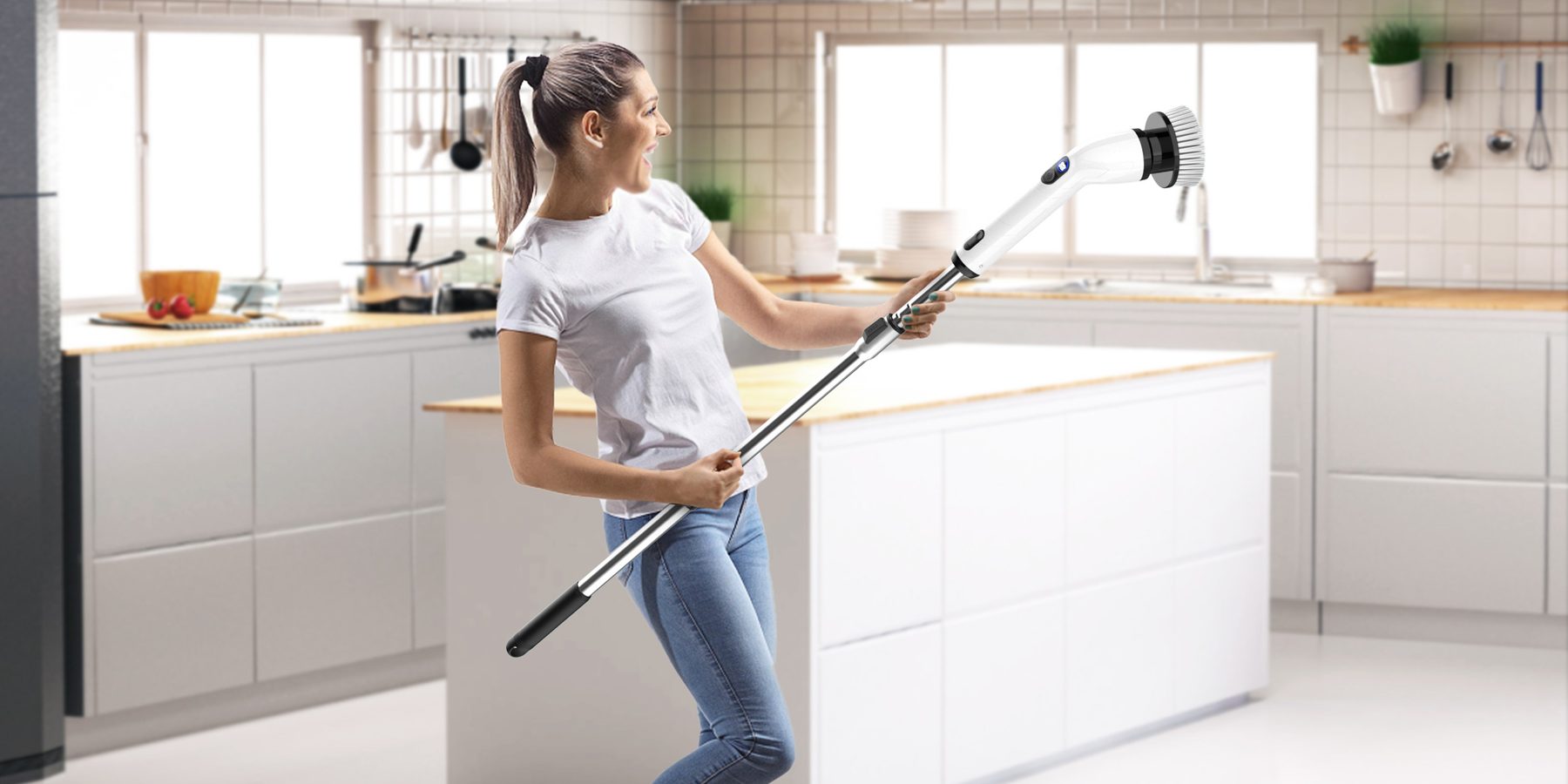
The best electric scrub brush for the shower is the one that reaches the top tile and the floor drain without you climbing or kneeling, keeps its speed when you press it into soap scum, and shrugs off a soaking. Here is how to judge a shower scrubber on each of those points, and how to use one so the shower walls come out sparkling in half the time.

Why an electric scrubber beats a manual brush in the shower
A shower is the hardest room in the house to scrub by hand. The walls are tall, the floor is low, the corners are tight, and the grime is a mix of soap scum, body oil and hard-water minerals that bonds to tile and glass. A manual scrubber relies on your pressure and your wrist; an electric scrubber relies on a motor that spins the brush head hundreds of times a minute, so you only guide it.
Testing by cleaning editors and buyer reports keep landing on the same point: power scrubbers save the most effort on large, wet, flat surfaces. That is a description of a shower. Where a manual brush still wins is tiny detail work around a faucet or a soap niche, and a good electric scrubber covers that too once you swap to a small head.
Power and speed: what 450 RPM means for soap scum
Speed is the number manufacturers lead with, and it matters, but steady speed under pressure matters more. A motor that slows as soon as you press the brush head into the wall is doing less work than its rating suggests. The TUYU electric spin scrubber runs at 350 RPM on low and up to 450 RPM on high; buyers who clean two full bathrooms on one charge report that it does not bounce or stall when pressure is applied.
Use the low speed for glazed tile, fiberglass and fixtures, where you want a gentle polish and less splash. Use the high speed for soap scum, the grey band at the bottom of the shower walls and the textured floor of the shower tray. Two speeds is enough; more settings rarely change the result.
The handle: reach the top tile and the floor without bending
If one feature decides whether a shower scrubber gets used, it is the handle. Bending and kneeling are what make the job tiring. An extendable handle that telescopes long enough to reach the top of the shower wall from the shower floor, and short enough to work the drain, is the single best upgrade over a manual brush.
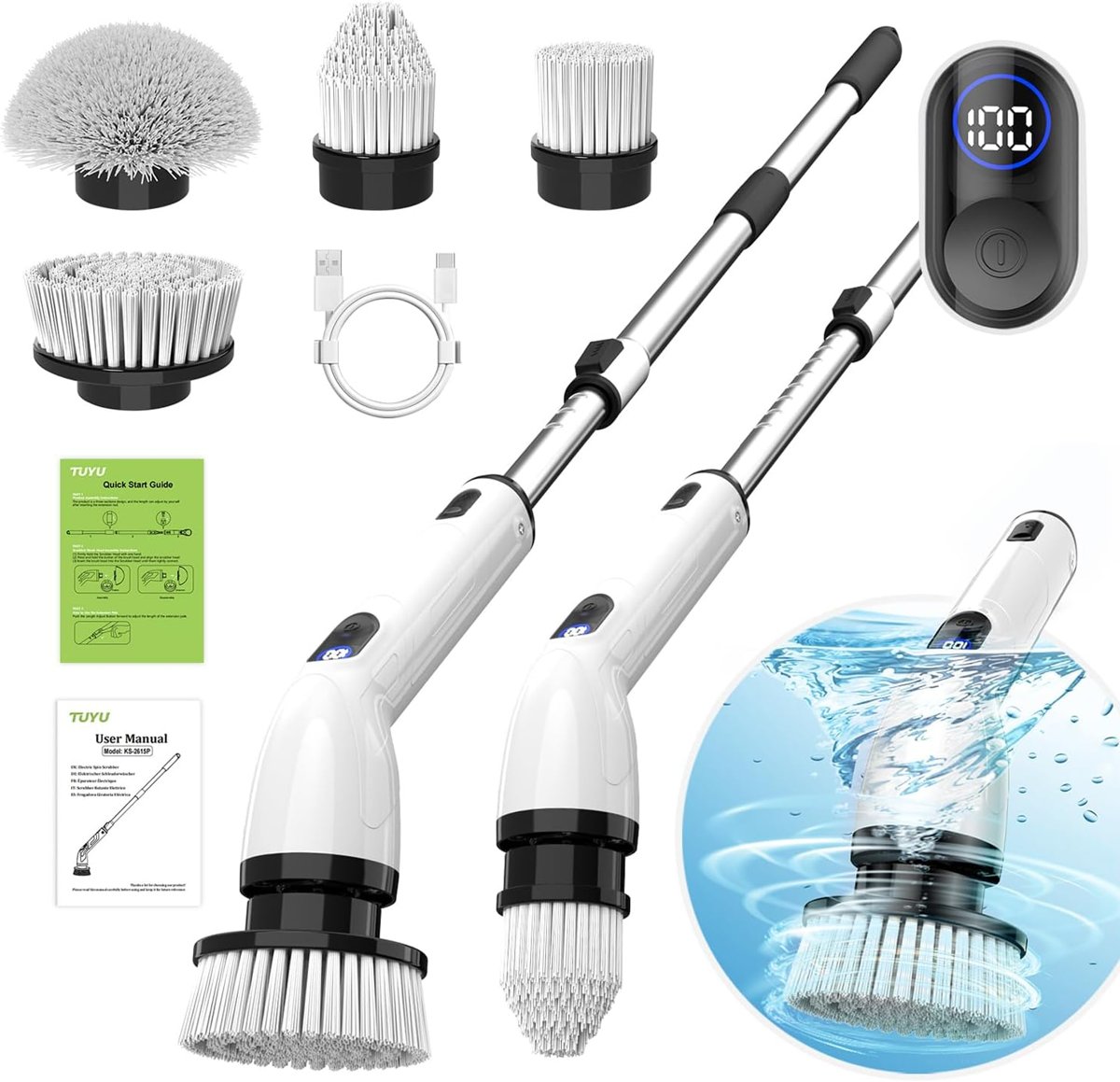
Look for a handle in the 25 to 50 inch range that locks firmly. The TUYU rod is stainless steel and extends from 26 to 45 inches; remove one section and the scrubber becomes a handheld brush for the sink or the base of the toilet. A comfortable grip and a light body matter too, because you hold the scrubber at arm's length for the whole clean.
Waterproofing: IPX7 and what full-body sealing adds
Every shower scrubber gets wet; the question is how wet. An IPX7 rating means the device can survive immersion in about a metre of water for half an hour, which is far more than spray. That rating lets you rinse the scrubber under the tap after a clean instead of wiping it down.
How do I choose a waterproof shower scrubber? Read whether the rating covers the whole body or only the head. The TUYU full-body IPX7 model moulds the shell in one piece and adds rubber sealing rings at the joints, so water running down the handle has no seam to get in through. If you like to clean with the shower running, that is the model to pick.
Battery life and charging
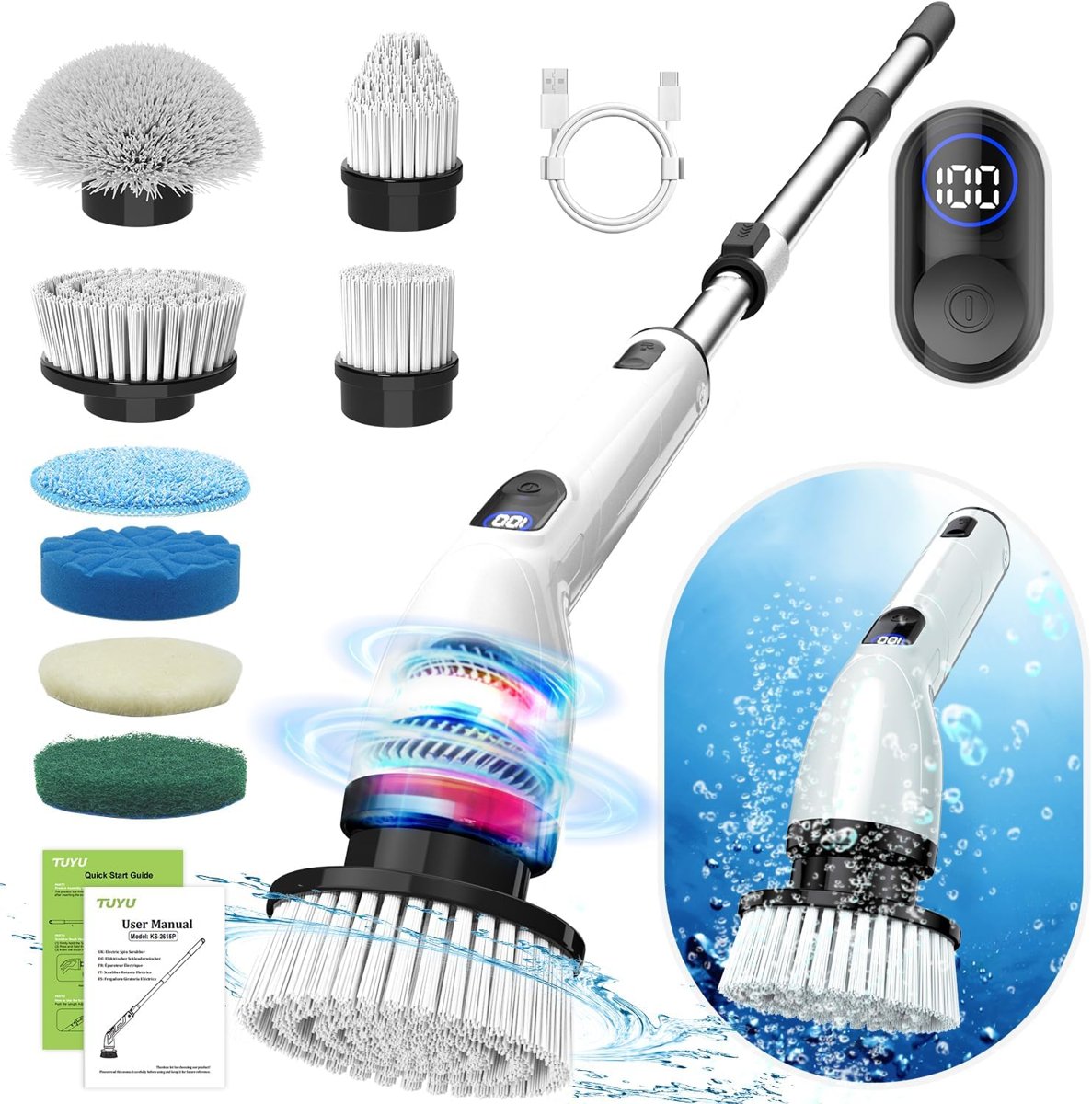
A shower clean takes ten to twenty minutes. A whole bathroom takes thirty to forty. Look for at least an hour of battery life so the scrubber does not die halfway down the wall. The TUYU scrubbers carry a 2500 mAh battery rated for up to 90 minutes, and an LED display on the body shows the charge level before you start.
Rechargeable models that use a Type-C cable are easier to live with than ones with a proprietary dock: any phone charger brick will do, and the cable is easy to replace. Full charge takes three to four hours; the indicator turns green when it is done.
Brush heads and attachments for shower walls, glass and grout
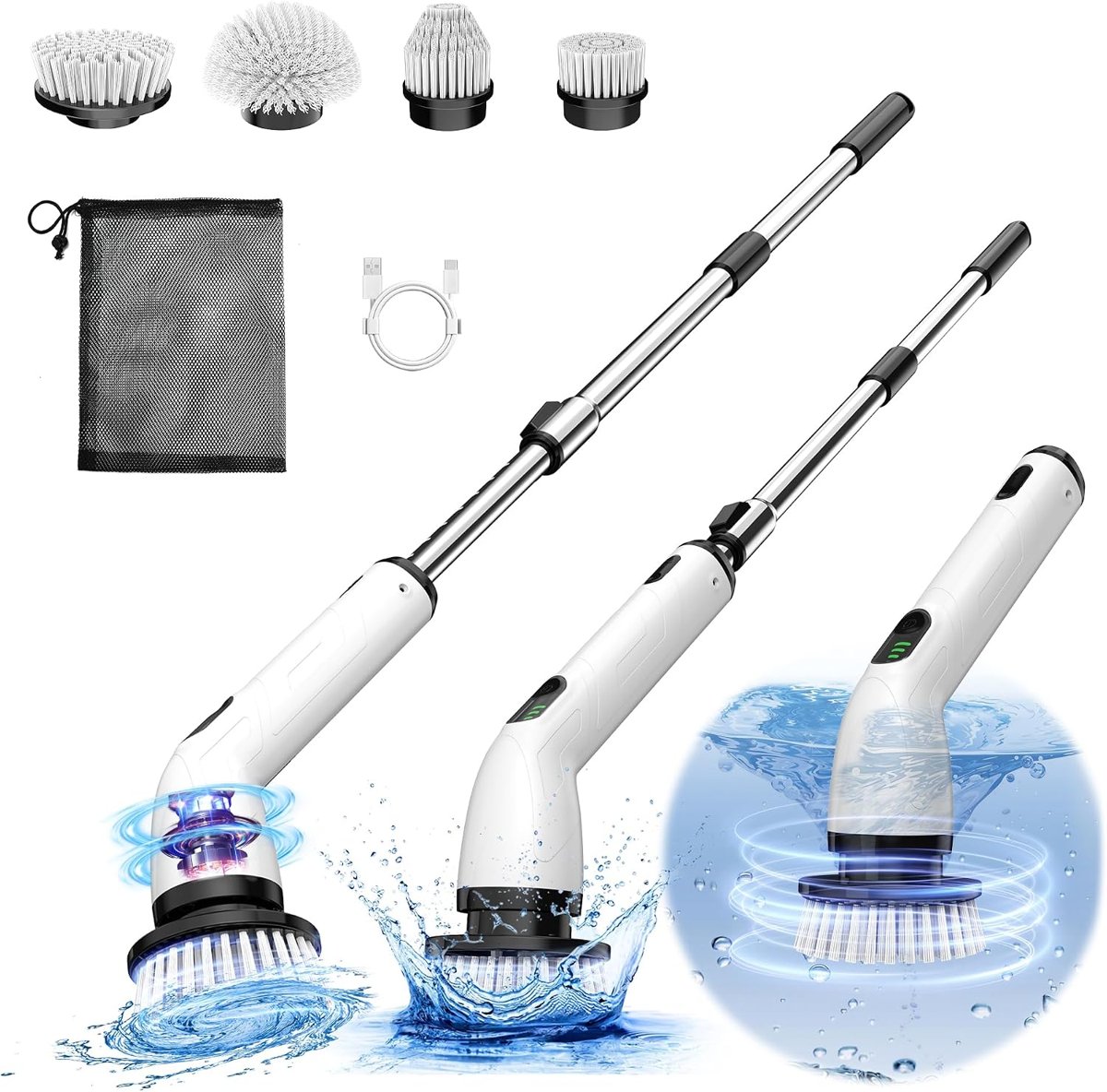
A large flat brush covers shower walls and the floor quickly. A dome brush follows curves: the tub, the toilet bowl, the inside of a basin. A small flat brush handles faucets, shelves and soap niches. A pointed corner brush is what gets into grout lines, the seam where wall meets tray and the ring around the drain. Pads are for glass doors, chrome and enamel, where bristles can leave fine scratches.
Kits with interchangeable brush heads give you all of these on one scrubber. The 4-head TUYU kit has the four brushes; the 8-head kit adds a sponge pad, a scouring pad, a polishing pad and an absorbent cloth. Bristles that resist shedding and spring back after a rinse will last longer, and replacement brush heads keep the scrubber useful when they finally wear.
How to clean a shower with an electric scrub brush
- Clear the shelves and run the water for a moment to wet the surfaces.
- Spray your usual shower cleaner on the walls, floor and glass and give it two or three minutes.
- Fit the large flat brush, set the handle to full length and work the walls top to bottom on high speed in slow, overlapping passes.
- Switch to the corner brush for grout lines, the corners and the drain ring.
- Use a pad on low speed for the glass door and the fixtures.
- Rinse the walls, then rinse the brush heads and the scrubber under the tap and hang it to dry.
Work from the top down so dirty water runs over areas you have not cleaned yet rather than ones you have. On the glass, move slowly; a spinning pad at speed throws water, and slow passes keep the splash down.
Design details that make a difference
Two scrubbers with the same motor can feel very different in the hand. Small design choices decide whether a power scrubber is comfortable for a whole clean: where the power button sits, whether the handle sections lock without wobbling, how heavy the head end is, and how easily the brush heads come off. Consider these before you look at the speed rating.
- A button you can press with your thumb without changing grip.
- An adjustable handle that locks firmly at every length.
- A head end light enough to hold against a wall without your shoulder doing the work.
- Brush heads that push on and pull off easily, so you actually switch to the right one.
- A battery display, so the scrubber does not stop halfway down the wall.
We found that the attachments matter as much as the motor. A versatile set, with a large flat brush, a dome, a corner cone and soft pads, gives you control over every surface in the shower; a single brush forces you to use the wrong tool on half of them.
Performance: what to expect from a power scrubber
An electric spin scrubber is effective on soap scum, body-oil film, grout haze and fresh hard-water spots. It will not undo years of mineral buildup on its own; that needs a descaling cleaner and some time, after which the rotating brush lifts what the cleaner has loosened. Testing by cleaning editors points the same way: power scrubbers cut scrubbing time and effort, especially on large tiled areas, but they work best paired with the right cleaner.
Expect the brush to do the circles and your hands to guide it. Light, even pressure gives better results than leaning on the handle, which slows the motor. If a spot needs more, slow the pass rather than pushing harder.
Electric vs. manual: which shower scrubber is right for you?
A manual scrubber is cheap, quiet and needs no charging, and for a small stall cleaned every few days it can be enough. An electric scrubber is the better choice if you have a large shower or a tub-shower combination, if you deal with hard water and soap scum, or if bending, kneeling and wrist strain are the reasons you put the job off. Buyers with lower back trouble describe it plainly: it saved their back and wrists.
Are electric scrubbing brushes worth it? If they turn a dreaded hour into a quick twenty minutes and you actually clean the shower more often because of it, yes. Choose one with a long handle, steady speed, real waterproofing, a battery that lasts the job and the right set of brush heads.